
Lint (code quality), Format and Auto-fix your groovy files and Jenkinsfile Visual Studio Code extension embedding npm-groovy-lint, itself embedding CodeNarc You can configure the rules by defining a.groovylintrc.json file If you use CI, you can integrate Mega-Linter in your workflow, to make sure all your sources (groovy and other) are clean. I have VS Code installed in an Ubuntu VM. I can't seem to get the python linter to work. I get a message saying. Linter pylint is not installed I am pretty sure pylint is installed on the VM because when I run which pylint I have a valied output. Here are the outputs.
Language Support for Java(TM) by Red Hat also provides formatting settings. You can export an Eclipse formatter file and then use it for your project in VS Code.
- At some point Visual Studio Code (VSCode) asked to update golang tools / settings, and it enabled linting. I searched on Google, but I found only results about setting the linter or disabling specific warnings. Go visual-studio-code. Improve this question. Follow edited Dec 3 '20 at 11:20.
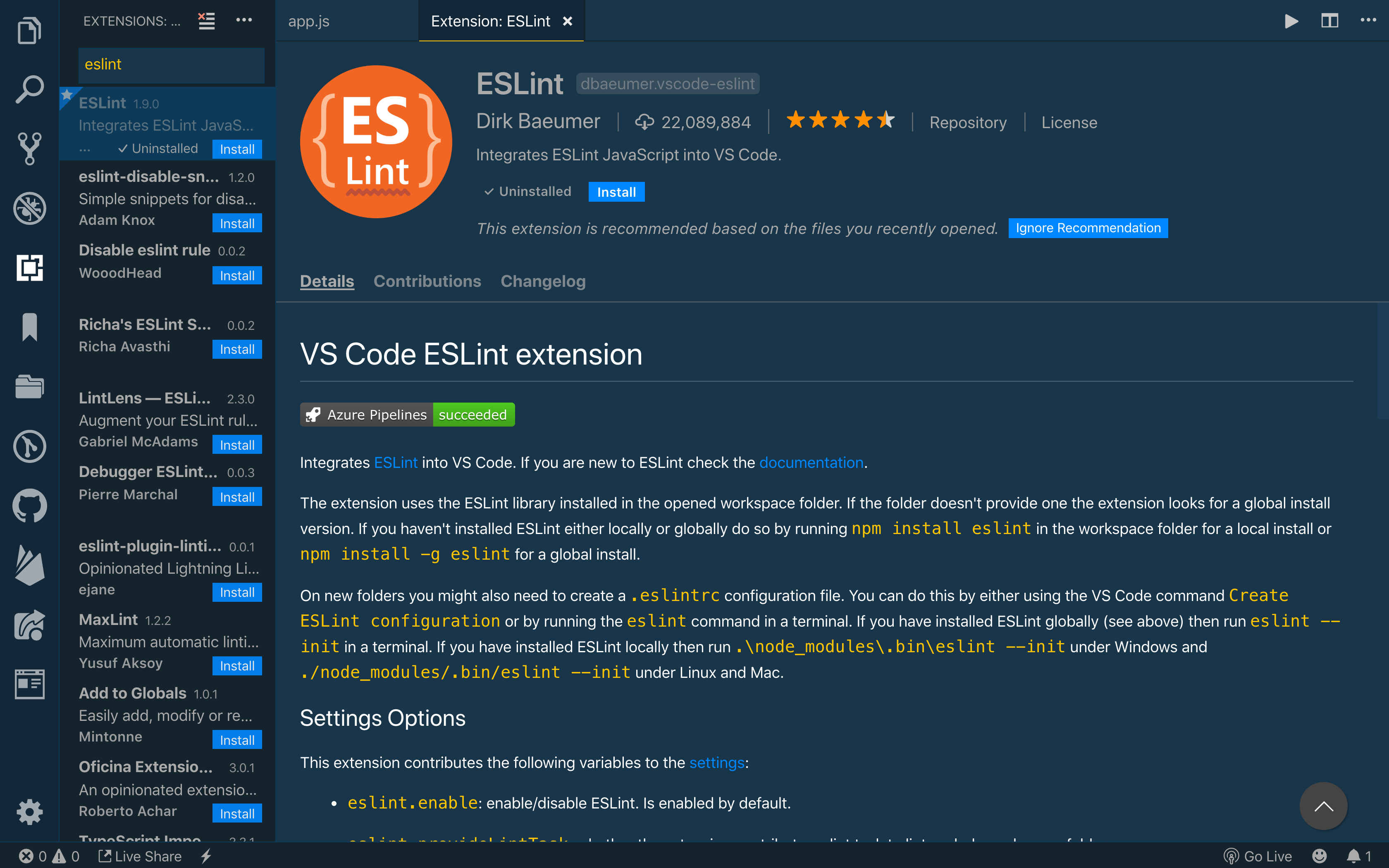
- To follow VS Code's model to confirm workspace local settings that impact code execution the two settings eslint.runtime and eslint.nodePath now need user confirmation if defined locally in a workspace folder or a workspace file. Users using these settings in those local scopes will see a notification reminding them of the confirmation need.
In addition, there are also the Checkstyle for Java and SonarLint extensions, which provide features for live linting and code analysis.
Checkstyle
With the Checkstyle for Java extension, you can use either existing checkstyle configurations (Google's or Sun's Check) or your own customized files for your project. When editing a Java file, the extension will check the file format and provide Quick Fixes if possible on the fly.
Set Checkstyle configuration file.
The Checkstyle for Java extension supports live linting.
And batch check.
The Problems panel will open when you click the Checkstyle status icon in the Status bar.
Set Checkstyle configuration file
To set the configuration file, right-click the
.xmlfile and select Set the Checkstyle Configuration File.You can also trigger the command Checkstyle: Set Checkstyle Configuration File to choose the configuration file in the File Explorer. The extension looks for a
checkstyle.xmlfile in your workspace to make Checkstyle configuration easier. You will also see the two built-in configurations:- Google's Check
- Sun's Check
Command Checkstyle: Set the Checkstyle Configuration detects potential Checkstyle configuration files and lists them. You can also provide a configuration file by directly writing a URL in the input box.
You can also set the Checkstyle version by using the command Checkstyle: Set the Checkstyle Version.
The command will:
- List the latest Checkstyle version from the main repo.
- List all the downloaded versions.
- List all the supported versions.
- Mark the currently used version with a check symbol.
In addition, you can also bring any 3rd-party modules for Checkstyle by configuring its path. For example, after using the configuration below, you can add <module name='SingleBreakOrContinueCheck'/> or <module name='com.github.sevntu.checkstyle.checks.naming.SingleBreakOrContinueCheck'/> to checkstyle.xml to leverage those checks.
Check the style and fix the violations
- When editing a Java file, the extension will check the file format and provide Quick Fixes if possible. You can click the lightbulb button in the editor to show the available Quick Fixes.
For more details about Checkstyle for Java, visit its GitHub Repository.
SonarLint
The SonarLint extension lets you detect bugs and vulnerabilities as you write code in VS Code. Java is one of the languages supported, and the extension will run in the background and highlight source code that poses a quality or security concern.
Code Analysis on the fly
Issues are highlighted directly in the editor with hovers to provide detailed explanations.
Issues found in the opened file can also be reviewed through the Problems panel of VS Code. When applicable, secondary code locations are mentioned so you can understand where the issue originates from (for example, the code path that led to a bug).
Rule documentation and remediation guidance
For any issue detected, SonarLint provides full documentation about the rule that was violated, and the coding best practice it relates to. This lets you understand why an issue is raised, and most importantly how to best fix it.
Enabling more quality and security rules
By default, SonarLint provides a wide array of rules to detect bugs and vulnerabilities. More checks can be enabled through the SonarLint Rules view.
For more details about the SonarLint for VS Code extension, visit the SonarLint website.
Formatter
Currently, you need an Eclipse formatter file like Google Style.
Set the following property:
The property can point to a URL or a local file path.
If the formatter XML file contains more than one profile, you can set the profile name:
You can also define the formatting preferences in your project's .settings/org.eclipse.jdt.core.prefs. It will override the global formatting settings.
We are working on a solution to allow editing your formatting preferences from within VS Code. For now, the best way to edit them is to use Eclipse. See Formatter Settings for details.
Linting highlights syntactical and stylistic problems in your Python source code, which oftentimes helps you identify and correct subtle programming errors or unconventional coding practices that can lead to errors. For example, linting detects use of an uninitialized or undefined variable, calls to undefined functions, missing parentheses, and even more subtle issues such as attempting to redefine built-in types or functions. Linting is thus distinct from Formatting because linting analyzes how the code runs and detects errors whereas formatting only restructures how code appears.
By default, stylistic and syntactical code detection is enabled by the Language Server. If you require third-party linters for additional problem detection, however, you can enable them by using the Python: Select Linter command and selecting the appropriate linter. You can easily enable and disable all linting by using the Python: Enable Linting command.
Enable linters
To enable linters other than the default PyLint, open the Command Palette (⇧⌘P (Windows, Linux Ctrl+Shift+P)) and select the Python: Select Linter command. This command adds 'python.linting.<linter>Enabled': true to your settings, where <linter> is the name of the chosen linter. See Specific linters for details.
Enabling a linter prompts you to install the required packages in your selected environment for the chosen linter.
Note: If you're using a global environment and VS Code is not running elevated, linter installation may fail. In that case, either run VS Code elevated, or manually run the Python package manager to install the linter at an elevated command prompt for the same environment: for example sudo pip3 install pylint (macOS/Linux) or pip install pylint (Windows, at an elevated prompt)
Disable linting
You can disable all Python linting with the Python: Enable Linting command, which shows a dropdown with the current linting state and options to turn Python linting on or off.
Run linting
To perform linting:
- Linting runs automatically when you save a file.
- Open the Command Palette (⇧⌘P (Windows, Linux Ctrl+Shift+P)), then enter and select Python: Run Linting.
Issues are shown in the Problems panel and as underlines in the code editor. Hovering over an underlined issue displays the details:
General linting settings
The remainder of this article describes settings for linting in general as well as specific linters. You can add any of the settings to your user settings.json file (opened with the File > Preferences > Settings command ⌘, (Windows, Linux Ctrl+,)). Refer to User and Workspace settings to find out more about working with settings in VS Code generally.
To change the linting behavior across all enabled linters, modify the following settings:
| Feature | Setting (python.linting.) | Default value |
|---|---|---|
| Linting in general | enabled | true |
| Linting on file save | lintOnSave | true |
| Maximum number of linting messages | maxNumberOfProblems | 100 |
| Exclude file and folder patterns | ignorePatterns | ['.vscode/*.py', '**/site-packages/**/*.py'] |
You can easily change python.linting.enabled by using the Python: Enable Linting command.
When enabling lintOnSave, you might also want to enable the generic files.autoSave option (see Save / Auto Save). The combination provides frequent linting feedback in your code as you type.
Specific linters
The following table provides a summary of available Python linters and their basic settings. Only Pylint is enabled by default. For descriptions of individual settings, see the Linter settings reference.
| Linter | Package name for pip install command | Default state | True/false enable setting (python.linting.) | Arguments setting (python.linting.) | Custom path setting (python.linting.) |
|---|---|---|---|---|---|
| Pylint (default) | pylint | Enabled | pylintEnabled | pylintArgs | pylintPath |
| Flake8 | flake8 | Disabled | flake8Enabled | flake8Args | flake8Path |
| mypy | mypy | Disabled | mypyEnabled | mypyArgs | mypyPath |
| pydocstyle | pydocstyle | Disabled | pydocstyleEnabled | pydocstyleArgs | pydocstylePath |
| pycodestyle (pep8) | pycodestyle | Disabled | pycodestyleEnabled | pycodestyleArgs | pycodestylePath |
| prospector | prospector | Disabled | prospectorEnabled | prospectorArgs | prospectorPath |
| pylama | pylama | Disabled | pylamaEnabled | pylamaArgs | pylamaPath |
| bandit | bandit | Disabled | banditEnabled | banditArgs | banditPath |
To select a different linter, use the Python: Select Linter command. You can also edit your settings manually to enable multiple linters. Note, however, that using the Select Linter command overwrites those edits.
Custom arguments are specified in the appropriate arguments setting for each linter. Each top-level element of an argument string that's separated by a space on the command line must be a separate item in the args list. For example:
Note that if a top-level element is a single value, as delineated by quotation marks or braces, it still appears as a single item in the list even if the value itself contains spaces.
A custom path is generally unnecessary as the Python extension resolves the path to the linter based on the Python interpreter being used (see Environments). To use a different version of a linter, specify its path in the appropriate custom path setting. For example, if your selected interpreter is a virtual environment but you want to use a linter that's installed in a global environment, then set the appropriate path setting to point to the global environment's linter.
The sections that follow provide additional details for those individual linters linked in the table. In general, custom rules must be specified in a separate file as required by the linter you're using.
Pylint
Pylint messages fall into the categories in the following table with the indicated mapping to VS Code categories. You can change the setting to change the mapping.
| Pylint category | Description | VS Code category mapping | Applicable setting (python.linting.) |
|---|---|---|---|
| Convention (C) | Programming standard violation | Information (green underline) | pylintCategorySeverity.convention |
| Refactor (R) | Bad code smell | Hint (light bulbs) | pylintCategorySeverity.refactor |
| Warning (W) | Python-specific problems | Warning | pylintCategorySeverity.warning |
| Error (E) | Likely code bugs | Error (red underline) | pylintCategorySeverity.error |
| Fatal (F) | An error prevented further Pylint processing | Error | pylintCategorySeverity.fatal |
Default Pylint rules
Python in Visual Studio code is configured by default to use a set of linting rules that are friendly to the largest number of Python developers:
- Enable all Error (E) and Fatal (F) messages.
- Disable all Convention (C) and Refactor (R) messages.
- Disable all Warning (W) messages except the following:
- unreachable (W0101): Unreachable code
- duplicate-key (W0109): Duplicate key %r in dictionary
- unnecessary-semicolon (W0301): Unnecessary semicolon
- global-variable-not-assigned (W0602): Using global for %r but no assignment is done
- unused-variable (W0612): Unused variable %r
- binary-op-exception (W0711): Exception to catch is the result of a binary '%s' operation
- bad-format-string (W1302): Invalid format string
- anomalous-backslash-in-string (W1401): Anomalous backslash in string
- bad-open-mode (W1501): '%s' is not a valid mode for open
These rules are applied through the following default arguments passed to Pylint:
These arguments are passed whenever the python.linting.pylintUseMinimalCheckers is set to true (the default). If you specify a value in pylintArgs or use a Pylint configuration file (see the next section), then pylintUseMinimalCheckers is implicitly set to false.
For the complete list of Pylint messages, see readable-pylint-messages (GitHub).
Command-line arguments and configuration files
See Pylint command-line arguments for general switches. Command-line arguments can be used to load Pylint plugins, such as the plugin for Django:
Options can also be specified in a pylintrc or .pylintrc options file in the workspace folder, as described on Pylint command line arguments.
To control which Pylint messages are shown, add the following contents to an options file:
You can easily generate an options file using Pylint itself:
For PowerShell you have to explicitly specify a UTF-8 output encoding:
The generated file contains sections for all the Pylint options, along with documentation in the comments.
pydocstyle
Command-line arguments and configuration files
See pydocstyle Command Line Interface for general options. For example, to ignore error D400 (first line should end with a period), add the following line to your settings.json file:
A code prefix also instructs pydocstyle to ignore specific categories of errors. For example, to ignore all Docstring Content issues (D4XXX errors), add the following line to settings.json:
More details can be found in the pydocstyle documentation.
Vs Linter
Options can also be read from a [pydocstyle] section of any of the following configuration files:
setup.cfgtox.ini.pydocstyle.pydocstyle.ini.pydocstylerc.pydocstylerc.ini
For more information, see Configuration Files.
Message category mapping
The Python extension maps all pydocstyle errors to the Convention (C) category.
pycodestyle (pep8)
Command-line arguments and configuration files
See pycodestyle example usage and output for general switches. For example, to ignore error E303 (too many blank lines), add the following line to your settings.json file:
pycodestyle options are read from the [pycodestyle] section of a tox.ini or setup.cfg file located in any parent folder of the path(s) being processed. For details, see pycodestyle configuration.
Message category mapping
The Python extension maps pycodestyle message categories to VS Code categories through the following settings. If desired, change the setting to change the mapping.
| pycodestyle category | Applicable setting (python.linting.) | VS Code category mapping |
|---|---|---|
| W | pycodestyleCategorySeverity.W | Warning |
| E | pycodestyleCategorySeverity.E | Error |
Prospector
Command-line arguments and configuration files
See Prospector Command Line Usage for general options. For example, to set a strictness level of 'very high,' add the following line to your settings.json file:
It's common with Prospector to use profiles to configure how Prospector runs. By default, Prospector loads the profile from a .prospector.yaml file in the current folder.
Because Prospector calls other tools, such as Pylint, any configuration files for those tools override tool-specific settings in .prospector.yaml. For example, suppose you specify the following in .prospector.yaml:
If you also have a .pylintrc file that enables the too-many-arguments warning, you continue to see the warning from Pylint within VS Code.
Message category mapping
The Python extension maps all Prospector errors and warnings to the Error (E) category.
Flake8
Command-line arguments and configuration files
See Invoking Flake8 for general switches. For example, to ignore error E303 (too many blank lines), use the following setting:
By default, Flake8 ignores E121, E123, E126, E226, E24, and E704.
Flake8 user options are read from the C:Users<username>.flake8 (Windows) or ~/.config/flake8 (macOS/Linux) file.
At the project level, options are read from the [flake8] section of a tox.ini, setup.cfg, or .flake8 file.
For details, see Flake8 configuration.
Message category mapping
The Python extension maps flake8 message categories to VS Code categories through the following settings. If desired, change the setting to change the mapping.
| Flake8 category | Applicable setting (python.linting.) | VS Code category mapping |
|---|---|---|
| F | flake8CategorySeverity.F | Error |
| E | flake8CategorySeverity.E | Error |
| W | flake8CategorySeverity.W | Warning |
mypy
Message category mapping
The Python extension maps mypy message categories to VS Code categories through the following settings. If desired, change the setting to change the mapping.
| mypy category | Applicable setting (python.linting.) | VS Code category mapping |
|---|---|---|
| error | mypyCategorySeverity.error | Error |
| note | mypyCategorySeverity.note | Information |
Troubleshooting linting
| Error message | Cause | Solution |
|---|---|---|
| ... unable to import <module_name> | The Python extension is using the wrong version of Pylint. | Ensure that the pythonPath setting points to a valid Python installation where Pylint is installed. Alternately, set the python.linting.pylintPath to an appropriate version of Pylint for the Python interpreter being used. |
| Linting with <linter> failed ... | The path to the Python interpreter is incorrect. | Check the pythonPath setting (see Environments). |
| The linter has not been installed in the current Python environment. | Open a command window, navigate to the location of the Python interpreter in the pythonPath setting, and run pip install for the linter. | |
| The path to the linter is incorrect. | Ensure that the appropriate python.linting.<linter>Path setting for the linter is correct. | |
| Custom arguments are defined incorrectly. | Check the appropriate python.linting.<linter>Args settings, and that the value of the setting is a list of the argument elements that are separated by spaces. For example, 'python.linting.pylintPath': 'pylint --load-plugins pylint_django' is incorrect. The correct syntax is 'python.linting.pylintArgs': ['--load-plugins', 'pylint_django']. |
Visual Studio Code Interactive Python
Next steps
- Debugging - Learn to debug Python both locally and remotely.
- Testing - Configure test environments and discover, run, and debug tests.
- Basic Editing - Learn about the powerful VS Code editor.
- Code Navigation - Move quickly through your source code.