
P-Channel MOSFETs, the Best Choice for High-Side Switching Historically, p-channel FETs were not considered as useful as their n-channel counterparts. The higher resistivity of p-type silicon, resulting from its lower carrier mobility, put it at a disadvantage compared to n-type silicon. Getting n-type performance out of p-type FETs has meant. A P-Channel MOSFET is a type of MOSFET in which the channel of the MOSFET is composed of a majority of holes as current carriers. When the MOSFET is activated and is on, the majority of the current flowing are holes moving through the channels. P-Channel MOSFETs, the Best Choice for High-Side Switching Historically, p-channel FETs were not considered as useful as their n-channel counterparts. The higher resistivity of p-type silicon, resulting from its lower carrier mobility, put it at a disadvantage compared to n-type silicon. Getting n-type performance out of p-type FETs has meant. Because, P type mosfet or transistor switch – on with Low, N type Mosfet or transistor switch- on with High signals! When you connect their bases or gates, since they have not resistance in between, they do complete the circuit and both are actively carrying current! So motor will get nothing! It is easy to remember: you should connect the Source pin of an N-Channel MOSFET to the negative output of your power supply, and the Source pin of a P-Channel MOSFET to the positive output of your power supply. The same rules apply to Depletion-Type N-Channel and P-Channel MOSFETs. Only ON and OFF state is inverted.
- P-type Semiconductor
- Mosfet P Type Injection
- P-type And N-type
- P Type Mosfet Symbol
- P Channel Mosfet Transistor
- Mosfet P Type For Sale
Connecting a P-Channel MOSFET to an Arduino can be a little trickier than an N-Channel MOSFET, but if you understand how it works, then it's not very complicated.
The main thing to understand about P-Channel MOSFETs is that they activate when the voltage on the Gate terminal is lower than the Source. It means that the Source of the MOSFET must be connected to the 5V output of the Arduino. Then the Arduino output pin LOW can be lower than the Source.
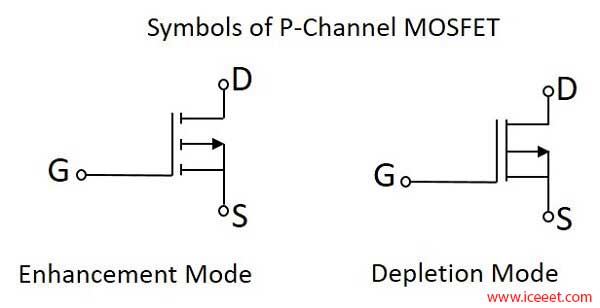
Symbols for P-Channel MOSFETs:
To simplify things, I am giving all the examples for the more common Enhancement-Type ('Normally OFF') MOSFETs - these are not conducting electricity when the voltage between the Gate and the Source (Vgs) is zero. The alternative Depletion-Type ('Normally ON') MOSFETs are a logical inversion of that. You can apply all the same examples and rules for a Depletion-Type MOSFET. Just the ON/OFF status is reversed.
In this article, I am going to explain all the necessary connections (and related dangers) to create the following diagram. And how to then control the power of the motor with an Arduino output pin.
Required Components
Disclosure: Bear in mind that some of the links in this post are affiliate links and if you go through them to make a purchase I will earn a commission. Keep in mind that I link these companies and their products because of their quality and not because of the commission I receive from your purchases. The decision is yours, and whether or not you decide to buy something is completely up to you.
Video Tutorial
A step-by-step guide about using a P-Channel MOSFET with an Arduino to switch a 12V motor ON and OFF.
P-Channel MOSFET on the 12V (VCC) Side of the Load
Let's say you want to turn ON and OFF a 12V DC motor using an Arduino and a P-Channel MOSFET.
The most intuitive way to archive this goal is to wire the MOSFET on the VCC side of the load (the motor in this case).

You need to have two power sources - one for the Arduino, and a separate 12V power source for the motor.
You cannot connect the Arduino's barrel jack to the 12V! This will create a common ground between your Arduino and the 12V power supply. And it would fry the Arduino when you are creating the common VCC needed for this circuit. (With an N-Channel MOSFET you don't have this problem since you want to have a common ground between the power source and the Arduino)
1. First, you need to create a Common VCC by connecting the positive output of the 12V power source to the Arduino 5V pin. DO NOT CONNECT THE GROUNDS!
2. Then connect the Source pin of the MOSFET to the VCC and the Drain pin to the positive lead of the motor.
Usually, you have common Ground between devices. But in this case, we need the Arduino to be able to put -5V on the Gate terminal of the P-Channel MOSFET. Connecting the Arduino 5V pin to the VCC (and the Source) will achieve this since now the Arduino output HIGH will be 0V on the Gate, and output low will be -5V on the Gate.
3. Connect the negative lead of the motor to the negative output of the 12V power supply.
4. With inductive loads (devices that have coils in them) like a motor, you need to add a flyback diode. It's a diode that is connected across the load in a reverse direction of the normal current flow. During motor operation, it doesn't do anything. But when the MOSFET switches OFF, the coil inside the motor will continue pushing electrons forward and will create a voltage spike. This can damage your MOSFET. The flyback diode allows the excess induced current to flow back and circulate inside the motor until all the energy is dissipated.
5. Add a 10k resistor between the Gate terminal and the VCC. It will ensure that the MOSFET is OFF while the Arduino pin is not initialized as OUTPUT yet, and is not actively driving the Gate (during startup, for example).
6. Finally, connect the Arduino digital output pin to the Gate via a 100-ohm resistor.
The 100-ohm resistor is necessary since the MOSFET will have a small internal capacitance. When you switch the digital output pin, it will start to charge/discharge, and it will create a current spike that can damage the Arduino Arduino pin, especially if you plan to do high-frequency switching.
P-Channel MOSFET on the Ground Side of the Load
I'll give this alternative connection diagram for educational purposes. Maybe it helps to understand the P-Channel MOSFET better.
You can also connect a P-Channel MOSFET below the load on the negative side of the power source. But here we don't have a common Ground nor a common VCC with the 12V power supply. Arduino 5V and GND pins are floating somewhere between the + and - outputs of the 12V power supply because there are no direct connections to them.
Since the MOSFET is activated or deactivated based on the voltage between the Gate and the Source, we need to make sure that the Arduino 5V pin is on the same level as the Source. So we need to connect the Source directly to the Arduino 5V pin.
It's the same case here that you cannot connect the grounds of the power supply and the Arduino! If you do that, you will apply more than five volts to the 5V pin (through the motor).
Arduino Code to Control the MOSFET
To drive a P-Channel MOSFET, you have to define one of the Arduino pins as OUTPUT and set it to HIGH to turn it OFF and set it to LOW to turn it ON.
HIGH state is OFF because the Source pin of the MOSFET is connected to the 5V output of the Arduino. It means that Vgs (voltage between the Gate and the Source) is 0V, and an Enhancement-Type MOSFET is turned OFF in this circumstance.
The following code will turn a motor ON and OFF every five seconds:
If you are controlling a motor or a lamp that can handle a PWM signal, then you can also use analog write command. For example, this will drive a motor at half the power or dim a LED light to 50 percent:
MOSFET is a metal oxide semiconductor that is under the category of the field-effect transistor (FET). These transistors are widely used under the varieties of the applications relating to the amplification and the switching of the devices. Because of its fabrication MOSFET’s are available in smaller sizes. It consists of a source, drain, gate and the substrate of the transistor as its terminals. For the circuitry of analog or it be digital this one is the widely preferred transistor. Based on the variation at the depletion region width and the flow of the majority concentration of the carriers the working of the MOSFET is classified as depletion type and enhancement type.
What is MOSFET?
A FET that is designed with the gate terminal being insulted from the substrate which is either the p-type or n-type material is called as Metal Oxide Semiconductor Field Effect Transistor. The Gate terminal which is a metal piece is insulated by material like silicon dioxide(Si02). The working of these MOSFETs depends upon the conduction of the charges through the channels based on the gate-source voltage.
Types of MOSFETs
Firstly based on the types of the channel it is classified as p-channel or n-channel MOSFETs. The presence of the channel in the transistor makes the MOSFET to operate into two different modes. If the channel exists and once the biasing is provided it starts to conduct then it is referred to as Depletion mode. Due to the biasing if the channel is created and then the conduction began then it is this referred to as Enhancement mode.
(1) Enhancement Mode
The application of the voltage makes the device to turn into ON mode known as Enhancement Mode. Generally, it is known for the characteristics similar to that of an open switch.
(2) Depletion Mode
In this mode, the application of the voltage makes the device turn into OFF mode. Hence these mode characteristics are equivalent to the closed switch.
MOSFET Symbol
The symbol of the MOSFET consists of the terminals and the representation of the channels based on the condition of the biasing and the way channel reacts to it make the device to conduct the flow of the charge carriers. The direction of the arrow in the below symbols represents the direction of the flow of charge carriers. In N- channel type it flows outward towards the gate and in P- channel type it flows inward away from the gate terminal.
Symbols for N-channel Depletion and Enhancement Types
Structure of MOSFET
The structure of the MOSFET is highly dependent on the influence of the majority of the charge carriers. Hence it makes the designing of this type of structure as the quite difficult one in comparison with the structure of the JFET. The formations of the electric field in this MOSFET either enhancement or depletion is completely dependent on the voltage applied at the terminal gate which in turn depends on the channel . If it is p-channel the majority of the concentration of the carriers will be holes and for n-type the majority of the concentration of the carriers are electrons.
Based on the biasing applied at the terminal gate the transistor conducts. If there is no conducting voltage provided then, in that case, it will remain in non-conducting mode. So these are generally preferred in switching the devices because it makes the device to turn ON or OFF based on the biasing.
Threshold Voltage
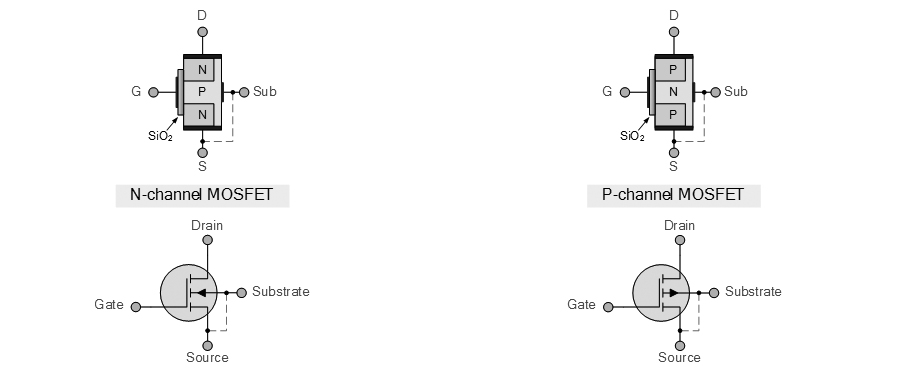
The voltage that is applied between the gate and the source terminal upon which the device turns on or off is called threshold voltage and it is also referred to as the gate voltage.
MOSFET Working
MOSFET working is highly dependent on the channel present in between the terminals. The presence of a p-type channel makes the transistor conduction possible due to its majority charge carriers referred to as holes. In the n-type channel, the transistor conductivity is based on their majority charge concentrations that are known as electrons.
(1) P-Channel
In this type of MOSFET, the source and drain are highly doped with a p-type material and they have very lightly doped n-type substrate. When the space between the drain and source are doped with a p-type impurities which becomes a channel between the source and the drain then it is a P-type depletion mode MOSFET and if the channel is formed between drain and source by the application of the gate voltage then it is P-type enhancement mode MOSFET.
P-Channel Enhancement Mode Working
P-type Semiconductor
Here the device starts conducting when a negative voltage is applied to the Gate terminal. When a negative voltage is applied to all the holes which are minority carriers in the n-type moves toward the gate terminal. But on its way, some of them combine with the some of the electrons which are minority carriers in the p-type drain and source. But at a particular voltage known as the threshold voltage, the holes will be able to overcome the recombination resulting in the formation of the channel between the drain and the source. Under this condition when a negative voltage is applied to the drain terminal the device starts conducting. Since the channel formed here is of holes it is called as P-channel Enhancement MOSFET.
P-Channel Depletion Mode Working
In this Mode when the gate voltage is zero and when a negative voltage is applied between the drain and the source then the holes start moving towards the drain because of the negative voltage and the device starts conducting. When a positive voltage is applied to the Gate terminal then the holes in the p channel get pushed toward the N-type substrate and start the recombine with the electrons in the N-type substrate. As the voltage increase, the number of recombination increases and this results in the depletion of the charge carriers(holes) which results in the reduction of the drain current. At a particular positive voltage of the gate terminal, the device stops conducting this voltage is called the Pinch-off voltage. When a negative voltage is applied to the Gate terminal then the holes which are the minority carriers in the n-type substrate moves directly towards the channel, as a result, the Drain current starts increasing. As the negative voltage of the Gate terminal increases the Drain current also increases. This region is called the Enhancement region.
P-Channel Depletion MOSFET
The variation in the width of the regions impacts the conductivity of the transistor. This is the reason it is known as the depletion type of p-channel MOSFET.
(2) N-Channel
In an N-type MOSFET, the source and the drain have a highly doped N-type material and lightly doped P-type substrate. Based on the way the channel is formed these are also classified as enhancement and the depletion type of MOSFETs.
N-Channel Enhancement Mode Working
The positive polarity of the voltage is considered here because n-channel consists of the majority of the carriers as electrons. The operation is similar to p-type MOSFET except that the device starts conducting when a positive voltage applied to the gate terminal. As the positive voltage in the gate terminal is increased at a particular threshold voltage and a channel gets formed drain and source. Under this condition, if a positive voltage is applied between the drain and source the device starts conducting.
Mosfet P Type Injection
N-Channel Depletion Mode Working
This mode of operation is similar to the P-type depletion-mode except that the drain to source terminal should be forward biased and a positive voltage should be applied to the Gate terminal for the current to flow from the drain to source. When a negative voltage is applied the major charge carriers get repelled towards the substrate and combines with the electrons resulting in the depletion of the major charge carriers in the channel and so then there will be a reduction in the drain current. At a particular negative voltage, the drain current becomes zero. This voltage is called a pinch-off voltage. Hence this type of MOSFET is known as the N-channel Depletion mode MOSFET.
N-Channel Depletion MOSFET
The enhancement mode is known for its characteristics based on the applied voltage whereas depletion is based on the variation of its width of the depletion region.
MOSFET Characteristics
The characteristics of the MOSFET are also dependent on the depletion and the enhancement modes.
P-type And N-type
Enhancement Mode Characteristics
The most preferred transistor in MOSFET is of enhancement type. In this type, there is no conduction seen if the voltage at the gate and the source terminals are zero. As the voltage reaches the threshold the conductivity tends to increase.
P Type Mosfet Symbol
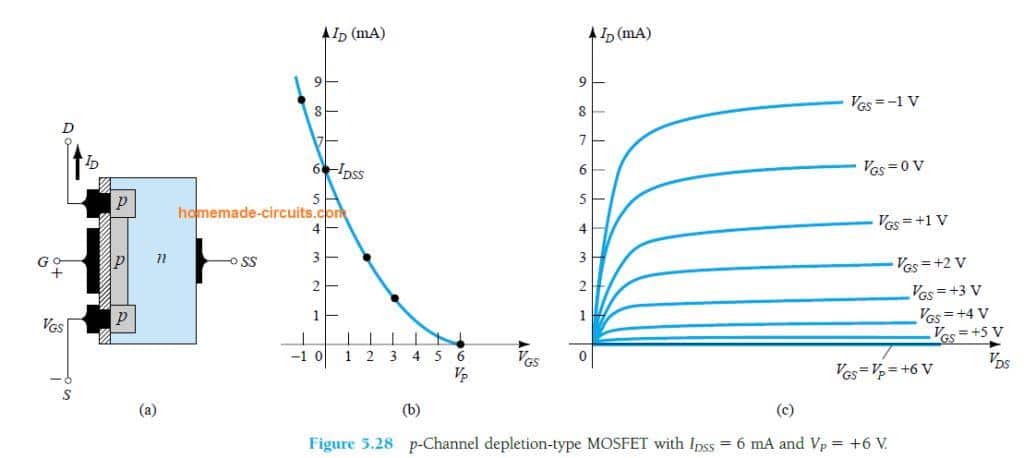
Depletion Mode Characteristics
In this mode, the width of this depletion region is dependent on the applied voltage at the terminal gate. If it is increased in terms of the positive polarity considered then this increment can be seen in the width of the depletion region. This mode of a transistor is very rarely preferred during the design of the electronic circuitry.
P Channel Mosfet Transistor
MOSFET Applications
The applications of the MOSFET are vast in terms of the electronics
Mosfet P Type For Sale
(1) The switching consequence of the devices based on the threshold value makes the MOSFET to work as a switch. Based on the channels the polarity of the biasing voltage may vary.
(2) By the application of the pulse-width modulation technique (PWM) the movement of the motors like DC, Stepper, etc… can get controlled.
(3) The amplifiers designed from these devices are used in the systems of the sounds as well as the radio frequency systems.
(4) The operation of the switching leads to the exploitation of the circuits of the chopper. In this, the value of the DC voltages is converted into the AC voltage by maintaining the same levels for the amplitudes.
(5) If the depletion region of the MOSFET is made in the configuration of the source follower then these circuits are utilized as the voltage regulators in the linear mode.
(6) As the sources that provide the constant value of the current these transistors are utilized.
(7) In order to drive the current or the value of the voltage at a high level, these are preferred in the circuits of oscillators or the mixers.
(8) These are the transistors with the impedance at the high level and possess the switching speed to be at a high level. Because of these characteristics, these are preferred for digital electronics.
(9) It is preferred in various types of systems of sound in the automobiles and the reinforced systems of the sound.
(10) These are preferred in the designing of the calculators.
Hence the above are some of the various applications of the MOSFET.
In this way, the types of MOSFETs are discussed. Though it has a complex design than JFET it is more preferred in analog and digital electronics. This has the features that are responsible for its tremendous growth in technology. Now based on the description can you anyone give an example of an application that used JFET but later replaced with the MOSFET?