
Install Jedicut for the first time
Thank you for downloading JEDict for Mac from our software library. The license type of the downloaded software for Mac OS X is shareware. This license type may impose certain restrictions on functionality or only provide an evaluation period. The download version of JEDict for Mac is 5.0.4. The download was scanned for viruses by our system.
- Search using romanized Japanese Hint: a second word (case sensitive) after the keyword will limit the search to entries containing the second word. Options: Restrict to common words EDICT only Require exact word-match (English keys) Limit matching to the start of words (kanji keys only).
- You hit on some stuff that I use. I have an iPod Touch and use Kotoba there along with Rikaichan on Firefox (the only time I don't use Safari is when I need to use Rikaichan!). I normally use JEDict on my laptop, never thought to try Dictionary. JEDict is kind of clunky sometimes so I think I'll check it out. June 25, 2010 at 10:04 PM.
- Execute Jedicut setup
- Follow instructions
Install Jedicut updates
The procedure is the same 🙂
If you use the setup file, it will detect the presence of an old Jedicut installation , and it will preserve all your settings files.

Do you like Jedicut ?
Jedicut is available for free from many years, unlike other softwares that costs 50, 100, ou 150$…
Jeddict Update Database
If you like Jedicut, donate with Paypal and support the project.
An alternative for experienced users
An alternative solution is to download a ZIP archive with Jedicut 2.4.2 containing all Jedicut files, and to drop them into the directory of your choice.
Warning : with this method you can have error messages under certain versions of Windows, at the launch of Jedicut. These messages are related to the presence of the io.dll. Just delete it. Jedicut doesn’t use this file on Windows versions that displays this error.
This page describes some Japanese-English dictionary software for Mac. (If you have not enabled Japanese input on your computer, visit the first page of this site now to find out how.)
Apple's Dictionary


Mac OS comes with a dictionary application (called simply 'Dictionary'). It includes a large Japanese dictionary and an English-Japanese/Japanese-English dictionary. (These are Super Daijirin and Wisdom waei/eiwa jiten, published by Sanseidō.)
The Japanese dictionaries are not activated by default; to enable them, you must open the Dictionary application, then open its preferences from the file menu and put a check mark by the dictionaries you want to use. Drag the Japanese-English and Japanese dictionaries so that the one you prefer to use as a default is on top.
Other Japanese Dictionary Software
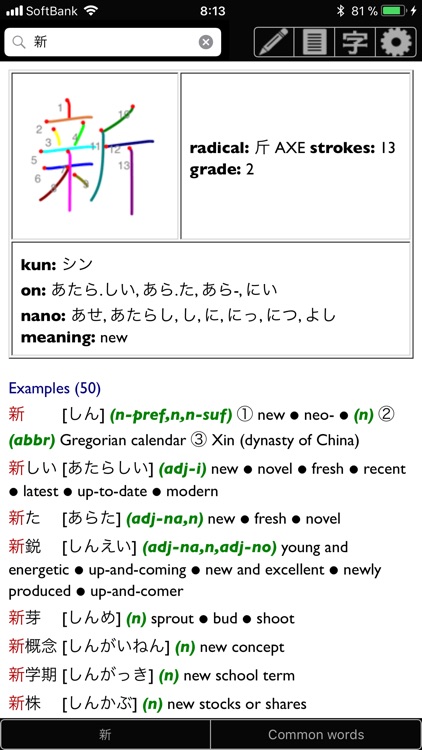
There are also third-party dictionaries with features keyed toward Japanese language learners--like integrated kanji dictionaries and the ability to create vocabulary lists. Most of these programs use the same publicly available dictionary files (the EDICT/JMDICT dictionaries described below), so the definitions will be the same, but the interfaces and features vary. My favorite options are the open-source Tagaini, and the feature-rich JEDict. When you register JEdict, you can also load additional dictionary files that cover specialized vocabulary. A particularly useful one is enamdict, a huge dictionary file of Japanese names.
Using the Dictionaries with Browsers, Email, etc.
Try this: highlight a word in Safari or Mail and select 'Look Up in Dictionary' from the Services menu (under the Safari menu just to the right of the apple menu): Apple's Dictionary application opens and displays a definition of the word. You can also control-click on the word and select 'Look up in Dictionary' from the pop-up menu, or press the Dictionary shortcut command-control-D: a pop-up window will open with definitions. If you have a trackpad and enable 'force click' in the system preferences, you can activate this pop-up window by putting the cursor on a word and pressing the track pad a little harder than usual. You can also use some of these tricks with other software, but Apple's Dictionary integrates best with Apple's own software, like Safari, Mail, and Pages.
Third-party dictionaries can also be invoked from the Services menu. After you install a program like JEdict, for example, you should see an item 'Look up in JEdict…' in the services menu, with its own keyboard shortcut.
If this option does not appear in the services menu, or if the shortcuts don't work, you may need to tweak some things in the System Preferences. Go to the Apple menu and select 'System Preferences,' then select the 'Keyboard' preferences pane, click on the 'Keyboard Shortcuts' tab, and finally select 'Services' in the lefthand pane. Find the relevant shortcut and make sure it is checked. If the keyboard shortcut is not working because of a conflict with another shortcut, you can double click directly on the shortcut and assign another key combination.
Dictionaries on the Web
Many English-Japanese dictionary programs and web sites use some variant of the EDICT/JMDICT dictionary files developed by Jim Breen at Monash University. Breen's own WWWJDIC web site is rather complex, but provides access to all of that dictionary's functionality.
Jedict Lite Android
NTT's goo dictionary server searches several large dictionary files, including Shōgakukan's Digital Daijisen, Random House eiwa jiten, and Progressive waei jiten.
Jedict Alternative
Eijirō, accessible from ALC's Home Page, is a large proprietary dictionary assembled by translators and users, said to be particularly strong on technical terms. (It has more than half a dozen entries beginning with 'deconstruct,' for example, including one for the Woody Allen movie Deconstructing Harry.) Even larger versons are available for a subscription fee.
Updated Jan 5, 2019